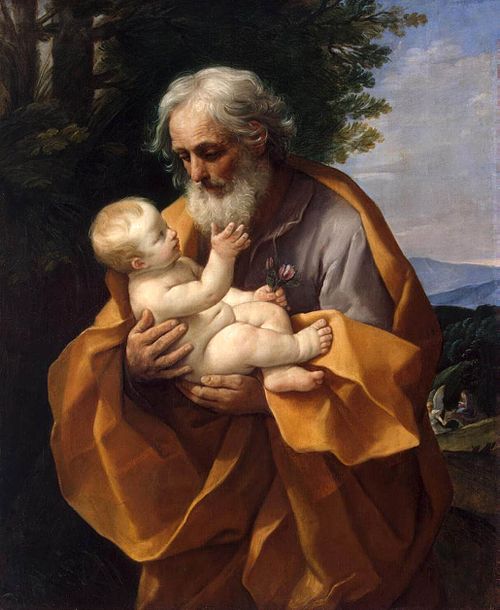
St. Joseph with the Child Jesus, by Guido Reni (c. 1620).
Life
Scriptural accounts identify Joseph as a carpenter of Davidic royal lineage who lived in Nazareth. Despite his noble ancestry, he was of humble means, as evidenced by his offering of affordable sacrifices at the Temple. He is characterized as a “righteous man” through his obedience to divine commands, his protection of Mary during her pregnancy, and his willingness to flee to Egypt to ensure the safety of Jesus. His regular observance of Passover and his anxious search for Jesus in Jerusalem further underscore his roles as a devout practitioner of his faith and a dedicated father.
Historical and ecclesiastical traditions suggest Joseph died before the start of Jesus’ public ministry, leading to his designation as the patron saint of a happy death. In the Catholic tradition, he is honored with two feast days: March 19, celebrating him as the Husband of Mary, and May 1, honoring him as Joseph the Worker. His patronage is extensive, covering the Universal Church, families, various professions, and numerous countries and regions worldwide.
In religious iconography, Joseph is commonly depicted as an older man with a beard (see above), often accompanied by symbols such as carpenter’s tools, a flowering staff, or lilies. While apocryphal sources provide specific dates for his birth and death, these details are not verified by the biblical canon. Ultimately, the primary significance of Joseph in Christian theology lies in his role as the legal protector and provider for the Holy Family.
Patronage
- The Universal Church
- Families and fathers
- Workers and carpenters
- The dying
Feast Days
- March 19 - Solemnity of Saint Joseph, Spouse of the Blessed Virgin Mary